1. I found this experience very, very helpful and insightful. It will change how my students complete research, prepare for tests and use online resources. The most helpful items I feel are the Learning Express Library for practice tests, also the NetLibrary, ProQuest, InfoTrac and lots of others. This has been very good- thanks for putting this together!
2. I have already shared this information with my fellow teachers during our last teacher in-service. I presented a little general information on the electronic resources and then demonstrated how to use the Learning Express Library, CAMIO, WorldBook and a few others. The short session was very well received and I have had numerous teachers ask me follow-up questions. Many are now using these resources as well I believe.
Thanks!!!
Saturday, March 26, 2011

Lesson 9- AncestryLibrary, HeritageQuest and Sanborn Maps
Will have to do AncestryLibrary at school... ooops, thought that one was available at home. I guess its only HeritageQuest.
1. I looked up myself and found predominantly old phone number and address information for myself.
2. So, then I looked up my grandparents and found a lot of documents and found this site facscinating!!!! I'm working on a shutterfly family story book and this will be lots of fun and very helpful! I found my parents' marriage registration, the birth info for all my mom's 11 siblings and lots of other info. Great site and its awesome and original copies are available through the viewer feature.
3. I used the maps feature and didn't have as much luck. I think if I spent lots and lots of time, maybe there would be a few things. I found it interesting that so many college/school yearbooks are included in this resource. I don't have ancestors who attended colleges or universities during these eras so, I didn't find as many family specific results. I did search for some items regarding South Dakota, Philip and the Bad River. No significant results that I saw but probably with more time and practice there may be some useful items there.
4. HertiageQuest- I looked up Haakon County since that is my hometown area. I found the Pioneers of the Open Range book by former/local residents of Haakon County. Its an old collection of pioneer stories of the settlers of Haakon County. I know, I have relatives in there- lots of them actually. It took me clicking through close to 40 pages but, I found it. I found a copy of the story of Mr. and Mrs. Lemuel Elshere. I already have a typed up copy of this story but it was fun to find in a resource like this. This is a great resource for maintaining the integrity of our lcoal/state history. This also motivated me to get back to work on my family history projects. Maybe once I'm done with this, national boards and state FCCLA, I'll get back to that this summer!!!
5. Sanborn Maps- I tried to look up Haakon County or any towns within Haakon County. Unfortunately, there was nothing. Which is sad- too bad there aren't some grants out there or something to help counties preserve some of these things. So, I went with Belle Fourche since I teach there and lived there for seven years. I found some old town maps which were kind of interesting. The town was so small then. They didn't even have the street where my former house is which was built in 1928 I believe. I was able to see where the old Belle bank buildings are located and figure out where some things still are today.
1. I looked up myself and found predominantly old phone number and address information for myself.
2. So, then I looked up my grandparents and found a lot of documents and found this site facscinating!!!! I'm working on a shutterfly family story book and this will be lots of fun and very helpful! I found my parents' marriage registration, the birth info for all my mom's 11 siblings and lots of other info. Great site and its awesome and original copies are available through the viewer feature.
3. I used the maps feature and didn't have as much luck. I think if I spent lots and lots of time, maybe there would be a few things. I found it interesting that so many college/school yearbooks are included in this resource. I don't have ancestors who attended colleges or universities during these eras so, I didn't find as many family specific results. I did search for some items regarding South Dakota, Philip and the Bad River. No significant results that I saw but probably with more time and practice there may be some useful items there.
4. HertiageQuest- I looked up Haakon County since that is my hometown area. I found the Pioneers of the Open Range book by former/local residents of Haakon County. Its an old collection of pioneer stories of the settlers of Haakon County. I know, I have relatives in there- lots of them actually. It took me clicking through close to 40 pages but, I found it. I found a copy of the story of Mr. and Mrs. Lemuel Elshere. I already have a typed up copy of this story but it was fun to find in a resource like this. This is a great resource for maintaining the integrity of our lcoal/state history. This also motivated me to get back to work on my family history projects. Maybe once I'm done with this, national boards and state FCCLA, I'll get back to that this summer!!!
5. Sanborn Maps- I tried to look up Haakon County or any towns within Haakon County. Unfortunately, there was nothing. Which is sad- too bad there aren't some grants out there or something to help counties preserve some of these things. So, I went with Belle Fourche since I teach there and lived there for seven years. I found some old town maps which were kind of interesting. The town was so small then. They didn't even have the street where my former house is which was built in 1928 I believe. I was able to see where the old Belle bank buildings are located and figure out where some things still are today.
Lesson 8
Part 1
1. I learned the following about Sitting Bull-
"Sitting Bull, also known as Tatanka Iyotake or Tatanka Iyotanka or Ta-Tanka I-Yotan, was a Native American shaman and leader of the Hunpapa Sioux. He fought against the Crow Indians and was wounded in battle on several occasions. Sitting Bull greatly opposed the encroachment of the white men. He led Sioux and Cheyenne warriors against U.S. soldiers of the 7th Cavalry at the battle of Little Bighorn. After the battle, in which many were killed, Sitting Bull led his tribe into Canada, where they lived until surrendering to U.S. forces. After his capture he toured with Buffalo Bill Cody's Wild West Show. Sitting Bull was killed while resisting arrest for his unwillingness to abandon the traditions of the ritual Ghost Dance, which had been outlawed." - Cornell University Library
2. I searched for Abraham Lincoln because my husband is a huge fan! It said that 2,905 documents were found. Many of these resources looked very useful and interesting. I'm sure that people writing biographies and writing books in general would especiall find this useful. For me, I was disappointed that it was simply a listing of resources and I couldn't view them immediately. Especially, where we live in a rural area very far from the larger metropolitan areas where most of these resources are located- I don't think I would be as likely to use this resource within a classroom setting. It is however, a valuable resource for personal use. I also looked up "Belle Fourche" since that is where I teach. More results showed up than I was expecting- this would be useful for history buffs with lots of time on their hands. They could definitely enjoy the hunt for information provided within this site.
CAMIO
1. The first item to show up is a tea urn. When I think of Paul Revere, I do not think of tea urns. Well, I never really think of tea urns. But, anyways...after scrolling down a little I found prints and paintings of the man himself as well as events and places related to his role in our country's history.
2. Sioux- This revealed over 60 findings. They were excellent photes, paintings, prints and legitimate artifacts realted to and showing the Sioux people and their lives. I think these could be very, very useful when used with Visual Thinking techniques and as discussion starters for students. Also, it is wonderful that the artifacts can be right click copy and pasted. This will allow students to use qualtiy photos instead of just random google things that look like they might be of the Sioux people without much basis for making that conclusion.
3. I looked up local artists including Terry Redlin and also John Crane. This did not result in any results. So, I then looked up the super well known Picasso which resulted in over 1,000 hits. I'm sure in our rural area, our regional artists probably aren't in museums as much as other places. It would be interesting to see if the Terry Redlin Museum would be interested in adding some prints to this site. I would think they would want them to be copy protected however, since he's marketing these heavily and wouldn't want to lose out on profits. It would be kind of fun to have a copy of the painting he did for the SD Capital last year. Art and History classes would find this resource especially useful.
4. As I said above, I really think that local history buffs would love this website. My father-in-law enjoys learning about Native American history and espeically the Battle of Little Big Horn. He's a former journalism teacher and really enjoys learning the story and pictures of these events. People such as him would really eat this up! Also, I would think that local historical societies would really use this alot as well. Realistically, I don't see high school kids getting too into this resource outside of a class assignment situation. Some kids grumble at the thought of a museum let alone a digital online one. Its a great tool to have though- I can really see using it in powerpoints and presentations.
5. I think this tool would be helpful for presentation. It seems very easy to use and would be nice to create a slideshow to be used with class or a community presentation. If I was a history teacher, I would definitely use this in creating my webpage or incorporate into my existing one.
1. I learned the following about Sitting Bull-
"Sitting Bull, also known as Tatanka Iyotake or Tatanka Iyotanka or Ta-Tanka I-Yotan, was a Native American shaman and leader of the Hunpapa Sioux. He fought against the Crow Indians and was wounded in battle on several occasions. Sitting Bull greatly opposed the encroachment of the white men. He led Sioux and Cheyenne warriors against U.S. soldiers of the 7th Cavalry at the battle of Little Bighorn. After the battle, in which many were killed, Sitting Bull led his tribe into Canada, where they lived until surrendering to U.S. forces. After his capture he toured with Buffalo Bill Cody's Wild West Show. Sitting Bull was killed while resisting arrest for his unwillingness to abandon the traditions of the ritual Ghost Dance, which had been outlawed." - Cornell University Library
2. I searched for Abraham Lincoln because my husband is a huge fan! It said that 2,905 documents were found. Many of these resources looked very useful and interesting. I'm sure that people writing biographies and writing books in general would especiall find this useful. For me, I was disappointed that it was simply a listing of resources and I couldn't view them immediately. Especially, where we live in a rural area very far from the larger metropolitan areas where most of these resources are located- I don't think I would be as likely to use this resource within a classroom setting. It is however, a valuable resource for personal use. I also looked up "Belle Fourche" since that is where I teach. More results showed up than I was expecting- this would be useful for history buffs with lots of time on their hands. They could definitely enjoy the hunt for information provided within this site.
CAMIO
1. The first item to show up is a tea urn. When I think of Paul Revere, I do not think of tea urns. Well, I never really think of tea urns. But, anyways...after scrolling down a little I found prints and paintings of the man himself as well as events and places related to his role in our country's history.
2. Sioux- This revealed over 60 findings. They were excellent photes, paintings, prints and legitimate artifacts realted to and showing the Sioux people and their lives. I think these could be very, very useful when used with Visual Thinking techniques and as discussion starters for students. Also, it is wonderful that the artifacts can be right click copy and pasted. This will allow students to use qualtiy photos instead of just random google things that look like they might be of the Sioux people without much basis for making that conclusion.
3. I looked up local artists including Terry Redlin and also John Crane. This did not result in any results. So, I then looked up the super well known Picasso which resulted in over 1,000 hits. I'm sure in our rural area, our regional artists probably aren't in museums as much as other places. It would be interesting to see if the Terry Redlin Museum would be interested in adding some prints to this site. I would think they would want them to be copy protected however, since he's marketing these heavily and wouldn't want to lose out on profits. It would be kind of fun to have a copy of the painting he did for the SD Capital last year. Art and History classes would find this resource especially useful.
4. As I said above, I really think that local history buffs would love this website. My father-in-law enjoys learning about Native American history and espeically the Battle of Little Big Horn. He's a former journalism teacher and really enjoys learning the story and pictures of these events. People such as him would really eat this up! Also, I would think that local historical societies would really use this alot as well. Realistically, I don't see high school kids getting too into this resource outside of a class assignment situation. Some kids grumble at the thought of a museum let alone a digital online one. Its a great tool to have though- I can really see using it in powerpoints and presentations.
5. I think this tool would be helpful for presentation. It seems very easy to use and would be nice to create a slideshow to be used with class or a community presentation. If I was a history teacher, I would definitely use this in creating my webpage or incorporate into my existing one.
Friday, March 25, 2011
Lesson 7- Worldcat and FirstSearch
Part1
1. I searched the term Suicide Prevention because that is something our school is dealing with right now. Many excellent resources came up in the search. There are 191 books by that title. The first book on the list, Suicide Prevention a Holistic Approach, can be found in 746 libraries. LC: RC569; Dewey: 362.28/7 is the call number information. This is a compilation of testimony basically which was provided to congress. It would be nice to be able to search this by zip code...then, we could see what is the nearest/most readilby available resource for us. However, I did notice that the publication date(s) were quite old. Users would need to keep this in mind when accessing these books, as is the case any time we use hard copy text.
2. Next, I looked up attachment parenting. I found many resources here as well- 260 items actually. These books sounded very interesting. I actually ended up clicking on the articles tab on the top and found over 100 articles. However, I still had a hard time full-text information. I really think that this site would be most useful to college students and even individuals pursuing advanced degress where they have the time, motivation and need for super in-depth research. I don't see high school students being willing to invest enough to pursue resources within this database. This is handy to know about though, if I ever pursue an advanced degree.
1. I searched the term Suicide Prevention because that is something our school is dealing with right now. Many excellent resources came up in the search. There are 191 books by that title. The first book on the list, Suicide Prevention a Holistic Approach, can be found in 746 libraries. LC: RC569; Dewey: 362.28/7 is the call number information. This is a compilation of testimony basically which was provided to congress. It would be nice to be able to search this by zip code...then, we could see what is the nearest/most readilby available resource for us. However, I did notice that the publication date(s) were quite old. Users would need to keep this in mind when accessing these books, as is the case any time we use hard copy text.
2. Next, I looked up attachment parenting. I found many resources here as well- 260 items actually. These books sounded very interesting. I actually ended up clicking on the articles tab on the top and found over 100 articles. However, I still had a hard time full-text information. I really think that this site would be most useful to college students and even individuals pursuing advanced degress where they have the time, motivation and need for super in-depth research. I don't see high school students being willing to invest enough to pursue resources within this database. This is handy to know about though, if I ever pursue an advanced degree.
Lesson 6- NetLibrary
1. I looked up a variety of topics including multiple intelligences in early childhood, interior design and then attachment parenting. These are topics that I used within my classroom. In the beginning I was not overly successful in finding books that really caught my eye. I believe this was because of the content I was searching for. I did find a lot of good books on this site. In the past, I used this site to look up samples for a short professional development session at my school. At that time, I found science reference books, nutrition handbooks and many other useful books. I did notice that only one person can have a 'book' open at once. If more than one person could have the book, then this site would be even more useful for in-class situations. We could then all open the same book and use it as a class resource for discussion, reading and group research. Still, this is a valuable resource.
2. Constitution Day-I searched for resources and found many matches. However, I guess I was hoping to find more ideas for activities and fun things to do on Constitution Day. Instead I found a lot of books about deep issues related to the constitution. I think this resource would be more useful for a research paper on the constitution instead of trying to find activities, etc.
3. Western History- I searched for Nebraska in the Publisher section. I think that many students, due to their Caucasian race, would be a little suprised to see that nearly all of the search findings are related to Native Americans. This is accurate and true to the time. However, some students may be expecting information related to pioneers, discovery of gold in the west, etc. I ended up reading a portion of the book Turtle Lung Woman's Granddaughter. It had accounts about the woman's life as a Native American woman. I think this resource would be useful for students looking for autobiographies or biographies.
2. Constitution Day-I searched for resources and found many matches. However, I guess I was hoping to find more ideas for activities and fun things to do on Constitution Day. Instead I found a lot of books about deep issues related to the constitution. I think this resource would be more useful for a research paper on the constitution instead of trying to find activities, etc.
3. Western History- I searched for Nebraska in the Publisher section. I think that many students, due to their Caucasian race, would be a little suprised to see that nearly all of the search findings are related to Native Americans. This is accurate and true to the time. However, some students may be expecting information related to pioneers, discovery of gold in the west, etc. I ended up reading a portion of the book Turtle Lung Woman's Granddaughter. It had accounts about the woman's life as a Native American woman. I think this resource would be useful for students looking for autobiographies or biographies.
Thursday, March 24, 2011
Lesson 5- Gale Reference Library
1. I searched the word nutrition and found numerous articles related to the topic. Within this I chose an article called Nutrition. The article discussed nutrition in infancy and childhood. The article provided a well-rounded set of information regarding child nutrition. It was full article pdf which I found useful as well. There were many other articles from a variety of stand points including information regarding specific vitamins and minerals. I believe this would be a great resource for students completing reports and also for FCCLA projects. In the future, I will refer them here when they are completing research related to their Illustrated Talks.
2. I looked up zinc in the basic search. At first, it looked intimidating however, I clicked the first article. After reading quite a bit of information I found information discussing what foods zinc is found in. Along the way however, I learned some 'bonus info' about the need for zinc in teenagers, especially in male teens. Next I looked up Huckleberry Finn resources. At first, I thought this was going to end up being much more challenging. However, I noticed that the articles are indexed by type of resource along the right hand side of the list. This is very, very useful! I quickly found a critical review of Huckleberry Finn discussing its literary role during this time of our country's history. I can see how this would be very useful in both research writing and also in class discussions. This is a great resource and it ended up being easier than I anticipated.
3. I looked around on a handful of other blogs....looks like I'm not the only one playing catch up. Some were quite critical of the Gale resources. However, I think this is a great site and feel that it may require a few extra clicks to find the info. In the end, the info of higher quality. I really liked it.
2. I looked up zinc in the basic search. At first, it looked intimidating however, I clicked the first article. After reading quite a bit of information I found information discussing what foods zinc is found in. Along the way however, I learned some 'bonus info' about the need for zinc in teenagers, especially in male teens. Next I looked up Huckleberry Finn resources. At first, I thought this was going to end up being much more challenging. However, I noticed that the articles are indexed by type of resource along the right hand side of the list. This is very, very useful! I quickly found a critical review of Huckleberry Finn discussing its literary role during this time of our country's history. I can see how this would be very useful in both research writing and also in class discussions. This is a great resource and it ended up being easier than I anticipated.
3. I looked around on a handful of other blogs....looks like I'm not the only one playing catch up. Some were quite critical of the Gale resources. However, I think this is a great site and feel that it may require a few extra clicks to find the info. In the end, the info of higher quality. I really liked it.
Monday, February 7, 2011
Lesson 4
1. This may sound odd but- I researched sexting because as a high school teacher, I feel this is a major issue that our schools, communities and judicial system must deal with. I found over 90 articles listed however, once I narrowed it to scholarly journals only one article remained. This is most likely due to the current newness of this topic that few research studies have been conducted completely and then are fully through the publication process. I really liked the tabs across the top which allow you to simply sort between magazines, newspapers, etc. for the type of resource needed. The articles are very current and provide great information about this current issue. I have had students use ProQuest some in the past however, I am going to require it much more often. We need kids using scholarly information and this an excellent resource for them to start good researching habits.
2. I checked close to 10 other blogs from our cohorts involved in this challenge. I was relieved to find out I'm not the only one who was a little behind on all of this. Thankfully, today is a snow day for me so I'm able to catch up on this. I tried to comment on BookBlogr's site however, blogger won't recognize my email and won't let me comment annonomously. So, sorry about that but hope this works in place of that.
3. For the publications tab... I scrolled through to find the Journal of Comparative Family Studies. I teach a class I like to call Family Sociology and feel that this journal would offer great text for this class. The article I read was full article including many statistics and comparison between family statistics throughout this past century. I find this information fascinating and could definitely use this for course content. These type of articles make for great discussions about the degree of which families really have or haven't changed. I back up all information with statistics so this would be very valuable. I'll be using this more!
2. I checked close to 10 other blogs from our cohorts involved in this challenge. I was relieved to find out I'm not the only one who was a little behind on all of this. Thankfully, today is a snow day for me so I'm able to catch up on this. I tried to comment on BookBlogr's site however, blogger won't recognize my email and won't let me comment annonomously. So, sorry about that but hope this works in place of that.
3. For the publications tab... I scrolled through to find the Journal of Comparative Family Studies. I teach a class I like to call Family Sociology and feel that this journal would offer great text for this class. The article I read was full article including many statistics and comparison between family statistics throughout this past century. I find this information fascinating and could definitely use this for course content. These type of articles make for great discussions about the degree of which families really have or haven't changed. I back up all information with statistics so this would be very valuable. I'll be using this more!
Lesson 3
SIRS Discover
1. I searched for resources about an octopus. At first, I was slightly disappointed because the news articles did not include pictures and looked somewhat un-interesting for elementary students who like bright colors, pictures, etc. However, then I realized that there was a picture tab which had 25 pictures of interesting looking octopuses including the zebra striped ones, blue-dotted ones and lots more. I think young learners would definitely enjoy this. It was nice being able to pick from a variety of magazine articles without filtering through a pile of wiki-space sources and random things found on google. The reading level would not be functional for early elementary however by the middle grades, most students should be able to find that most resources are within their ability in my opinion. However, with very little training, students will be able to pick up on what color they should look for in order to match up with their reading level. This is an excellent 'tool' in making this resources more efficient for teachers and learners. This feature makes this resource even more user friendly.
2. When I went to the Country Facts link I was suprised at how many relatively unknown countries were listed. For the fun of it, I looked up Nauru- a country I had never heard of before. Because I had no idea where it was, I went back to the Maps link and learned that it is a tiny island just over 3 miles long, with an air strip and a phosphate mine on a little plateau in the center of the island. 13,000 people live there and they have a GDP of $5,000 per person. Their president Marcus Stephens leads the country. Although this is an unknown country, this resource still had a very complete set of information irregardless of its lack of presence on the world stage so to speak.
Lastly, I used the biography feature to do some searching. I realize that this is not a complete list however, what is available and what isn't available was interesting to me. My husband recently read a book on William Wilberforce- a great man who worked for 15 years to end the African slave ship trade. This was a major social, cultural and racial accomplishment. He played a very key role in transforming society. He does not have a biography listed. I looked up Billy Graham- nothing listed. I looked up Martin Luther- nothing listed. I looked up Pope Benedict- biography listed, I looked up Jesus- nothing listed, I looked up Buddha- info listed. Martin Luther King- much listed. I guess, I found it very interesting as to what was included in this datebase and what wasn't. From the standpoint of a very quick assessment, it appears that there are some irregularities in what content is included and what isn't. Because of its incompleteness, I think I will utilize other resources than this biography feature unfortunately. If a student was assigned to write a paper on his/her hero- it appears that some valid biographies are missing from this database.
SIRS Researcher
I researched the topic of adoption. I found many articles related to a variety of topics and factors related to adoption. Many of them focused on the changes in international adoption regarding regulations, corruption and Hague Accredidation. The timeline is very useful- this provides a very broad perspective of the content in a very quick and efficient way. I really liked the graphs/charts that come up along the top- it makes it very quick and handy to find and use. These would be wonderful for power point presentations or as discussion starters for my Child Development and/or Family Sociology classes. I will be pointing my students here the next time they do an Illustrated Talk on a social issue related to families. I also think that many kids would like the 'visual browse' feature in which they can float through their research in a very fun way. The Curriculum Pathfinder feature has a very large selection. I clicked on the health tab and then the nutrition heading. I was pleased to find many magazine articles and much information there. These would be very useful for independent reading time at the beginnig of a class hour or after taking a test when time-fillers are needed. These articles could also be used for discussion and/or debate starting points.
1. I searched for resources about an octopus. At first, I was slightly disappointed because the news articles did not include pictures and looked somewhat un-interesting for elementary students who like bright colors, pictures, etc. However, then I realized that there was a picture tab which had 25 pictures of interesting looking octopuses including the zebra striped ones, blue-dotted ones and lots more. I think young learners would definitely enjoy this. It was nice being able to pick from a variety of magazine articles without filtering through a pile of wiki-space sources and random things found on google. The reading level would not be functional for early elementary however by the middle grades, most students should be able to find that most resources are within their ability in my opinion. However, with very little training, students will be able to pick up on what color they should look for in order to match up with their reading level. This is an excellent 'tool' in making this resources more efficient for teachers and learners. This feature makes this resource even more user friendly.
2. When I went to the Country Facts link I was suprised at how many relatively unknown countries were listed. For the fun of it, I looked up Nauru- a country I had never heard of before. Because I had no idea where it was, I went back to the Maps link and learned that it is a tiny island just over 3 miles long, with an air strip and a phosphate mine on a little plateau in the center of the island. 13,000 people live there and they have a GDP of $5,000 per person. Their president Marcus Stephens leads the country. Although this is an unknown country, this resource still had a very complete set of information irregardless of its lack of presence on the world stage so to speak.
Lastly, I used the biography feature to do some searching. I realize that this is not a complete list however, what is available and what isn't available was interesting to me. My husband recently read a book on William Wilberforce- a great man who worked for 15 years to end the African slave ship trade. This was a major social, cultural and racial accomplishment. He played a very key role in transforming society. He does not have a biography listed. I looked up Billy Graham- nothing listed. I looked up Martin Luther- nothing listed. I looked up Pope Benedict- biography listed, I looked up Jesus- nothing listed, I looked up Buddha- info listed. Martin Luther King- much listed. I guess, I found it very interesting as to what was included in this datebase and what wasn't. From the standpoint of a very quick assessment, it appears that there are some irregularities in what content is included and what isn't. Because of its incompleteness, I think I will utilize other resources than this biography feature unfortunately. If a student was assigned to write a paper on his/her hero- it appears that some valid biographies are missing from this database.
SIRS Researcher
I researched the topic of adoption. I found many articles related to a variety of topics and factors related to adoption. Many of them focused on the changes in international adoption regarding regulations, corruption and Hague Accredidation. The timeline is very useful- this provides a very broad perspective of the content in a very quick and efficient way. I really liked the graphs/charts that come up along the top- it makes it very quick and handy to find and use. These would be wonderful for power point presentations or as discussion starters for my Child Development and/or Family Sociology classes. I will be pointing my students here the next time they do an Illustrated Talk on a social issue related to families. I also think that many kids would like the 'visual browse' feature in which they can float through their research in a very fun way. The Curriculum Pathfinder feature has a very large selection. I clicked on the health tab and then the nutrition heading. I was pleased to find many magazine articles and much information there. These would be very useful for independent reading time at the beginnig of a class hour or after taking a test when time-fillers are needed. These articles could also be used for discussion and/or debate starting points.
Lesson 2
1. I set up my Learning Express Account and was very pleased to find so many useful resources. I feel this resource would be especially useful for our guidance counselor as well. I like how they have each section divided up according to the audience looking for a practice test. I did not realize there was a central location for practice tests such as this.
2. I took part of the reading comprehension test because I have a 'project student' that I'm trying help regarding her ability to comprehend what she reads. The test is very much what I remember of a standardized test. I believe this would be very helpful in providing students with some practice tests leading up to our spring tests. I also looked at the spelling/vocabulary tests as well. I was expecting them to be more introductory and to help struggling students. However, I found them to be at a quite advanced level.
3. I teach life skills concepts such as building resumes and interviews. I looked through some of the downloadable books and found them to be very informative. I can really see these being very helpful for indepedent study students and as a regular classroom resource. These are great!
4. The first term I typed in was 'Food Safety' in hopes that sample Serve Safe tests would be available. However, it didn't appear that there were any unless I just missed them. I was glad to see that there are sample realtor tests, postal worker tests, electrician tests, etc. I think these would be great tools when kids have an interest in these occupations. They can take a look at the test to see what type of knowledge and ability would be required to pass a test of that caliber. Sometimes, students have lofty ideas of their career dreams without considering their natural talents, abilities and willingness to acquire the required training.
Overall, this is a great resource. Our administration continually asks us how we will help prepare our students for the state tests. I will be setting aside some time to utilize these tests. Even though they're not super closely related to my content area, if kids improve their reading comprehension and critical thinking skills- they will do better in all content areas. Thanks for sharing this resource- I really look forward to utilizing it! I'll also be passing this along to our guidance counselor and administration.
2. I took part of the reading comprehension test because I have a 'project student' that I'm trying help regarding her ability to comprehend what she reads. The test is very much what I remember of a standardized test. I believe this would be very helpful in providing students with some practice tests leading up to our spring tests. I also looked at the spelling/vocabulary tests as well. I was expecting them to be more introductory and to help struggling students. However, I found them to be at a quite advanced level.
3. I teach life skills concepts such as building resumes and interviews. I looked through some of the downloadable books and found them to be very informative. I can really see these being very helpful for indepedent study students and as a regular classroom resource. These are great!
4. The first term I typed in was 'Food Safety' in hopes that sample Serve Safe tests would be available. However, it didn't appear that there were any unless I just missed them. I was glad to see that there are sample realtor tests, postal worker tests, electrician tests, etc. I think these would be great tools when kids have an interest in these occupations. They can take a look at the test to see what type of knowledge and ability would be required to pass a test of that caliber. Sometimes, students have lofty ideas of their career dreams without considering their natural talents, abilities and willingness to acquire the required training.
Overall, this is a great resource. Our administration continually asks us how we will help prepare our students for the state tests. I will be setting aside some time to utilize these tests. Even though they're not super closely related to my content area, if kids improve their reading comprehension and critical thinking skills- they will do better in all content areas. Thanks for sharing this resource- I really look forward to utilizing it! I'll also be passing this along to our guidance counselor and administration.
Friday, January 21, 2011
Lesson 1A
WORLD BOOK KIDS
Meerkats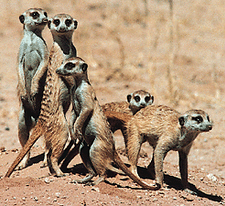
Meerkats live in open dry land where the ground is hard and stoney.
WORLD BOOK STUDENT EDITION
The World Book Student Edition has more detailed and scientific information about meerkats. More specific information is available including scientific name, size measurements and greater detail related to physical features.
Meerkat is a small burrowing animal of Africa. It lives from southwestern Angola to South Africa. The meerkat, also called suricate, is found in open, dry country where the ground is hard and stony.
Adult meerkats measure about 20 inches (51 centimeters) long, including a tail of about 8 inches (20 centimeters). They weigh about 2 pounds (900 grams). Meerkats have front feet with strong, curved claws for digging, and stocky hind legs. They have broad, rounded heads and sharply pointed noses. Most meerkats are silvery-brown, with dark bands across their backs.
Meerkats live in underground colonies of up to 30 individuals. Their burrows have many tunnels and entrances. Meerkats leave their burrows only during the day. They often stand upright, exposing their chests and bellies to the sun. They also stand upright to search for large birds that hunt them. Meerkats eat mostly spiders and insects, including beetles and grasshoppers.
WORLD BOOK ADVANCED- Ethiopia
I chose the country of Ethiopia because this will be the homeland our adopted child. I found the pictures, maps and tables to be very useful. I feel that these would be most useful because a lot of information can be acquired very quickly from these visual resources.
WORLD BOOK DISCOVERY
This resource has options to switch the World Book to either Spanish or French with just a simple click of the button. This would be incredibly helpful to many students- how efficient, useful and valuable!!
Subscribe to:
Posts (Atom)